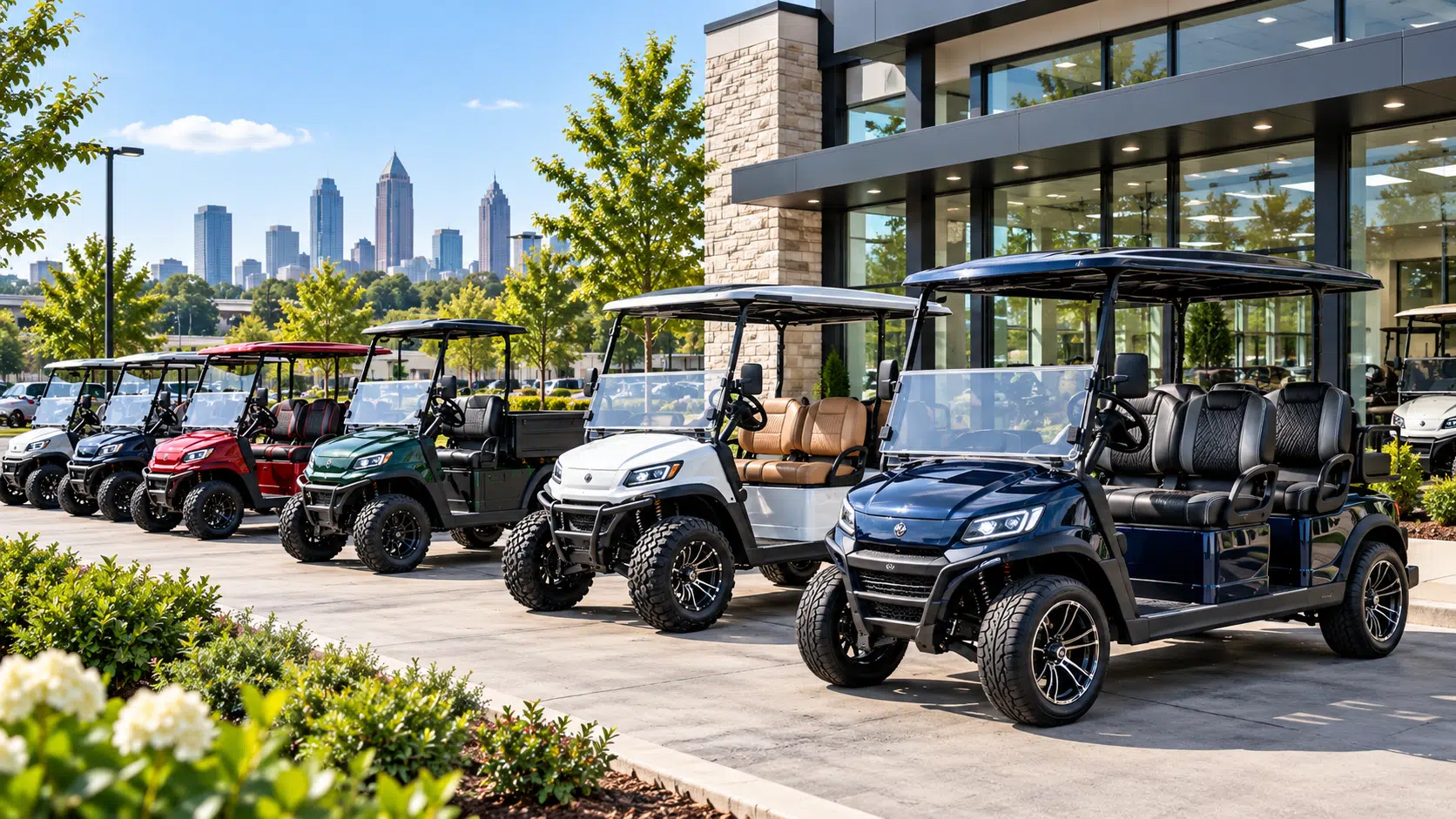




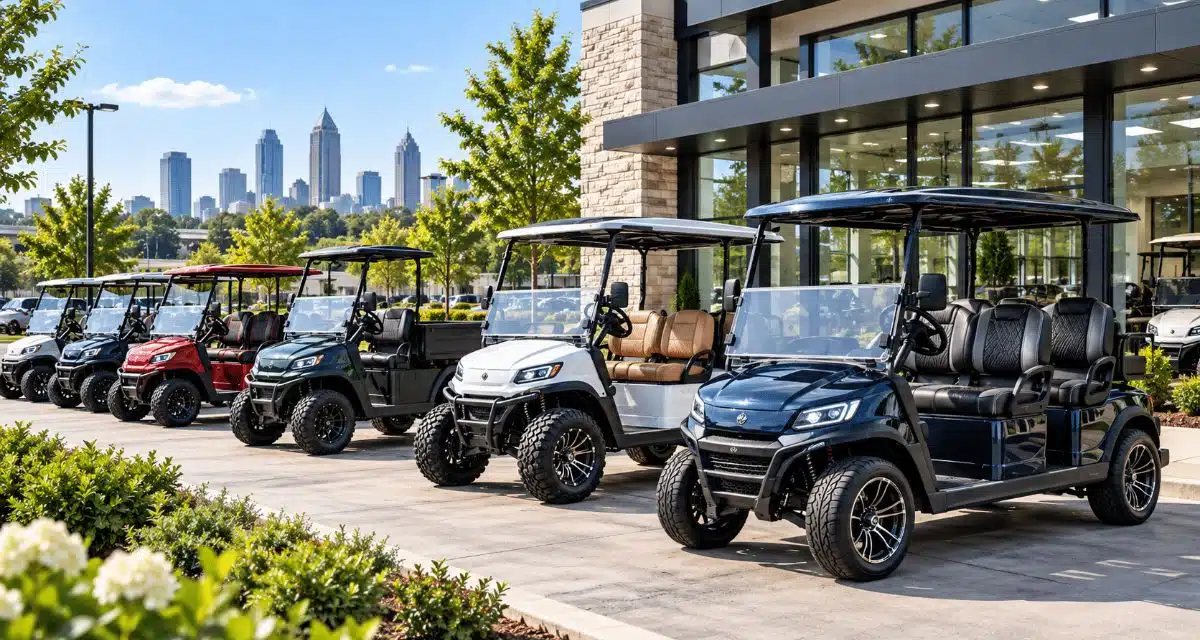
Electric golf carts are quieter, have fewer engine parts to maintain, and produce no exhaust, which makes them a natural fit for neighborhoods and for work areas that are enclosed or close to people. Gas golf carts refuel in a few minutes and don’t depend on hours of charging, which can suit long days, large or remote property, and operations that can’t wait on a charger. The better choice comes down to how far you drive each day, where the cart is parked and charged, and who will handle the upkeep.
We sell new carts and service both gas and electric models every day in Marietta, so here’s a plain comparison from the service bay. You won’t find a price chart here, because prices depend on the model, battery type and options and they change often. Call us for current availability and numbers.
Gas vs. Electric at a Glance
- Maintenance: electric carts skip engine service such as oil, filters and spark plugs. Gas carts need regular engine care. Both need brakes, tires and steering checked.
- Noise: electric carts are close to silent. Gas carts are louder, though some newer gas designs are much quieter than older ones.
- Exhaust: electric carts have none. Gas engines produce carbon monoxide and shouldn’t run indoors.
- Refueling: gas takes minutes at a pump or can. Electric carts need regular charging time and an outlet where they park.
- Range: both vary by model, load, terrain and conditions. For electric carts, battery type and capacity make a big difference.
Maintenance: What Each Type Needs
Electric carts
Electric drivetrains are mechanically simpler. The U.S. Department of Energy’s Alternative Fuels Data Center notes that electric vehicles have “fewer fluids, such as engine oil, that require regular maintenance” and “far fewer moving parts relative to a conventional fuel engine.” That’s written about electric vehicles in general, but the same logic applies to golf carts.
The battery is where electric carts need attention. Flooded lead-acid packs need regular charging, watering with distilled water, and clean connections, as Trojan Battery’s user’s guide lays out. Lithium packs remove most of that routine: Trojan’s lithium FAQ describes its lithium golf battery as not needing watering, equalizing or maintenance charges, while still recommending regular visual inspection. Either way, the battery pack is the big long-term cost to plan for.
Gas carts
Gas carts have a small engine, and engines need routine care: oil level and oil changes, air filter, spark plug, the fuel system, and belts, on the schedule in your owner’s manual. E-Z-GO’s gas-powered Refresher owner’s manual, for example, tells operators to add oil if the level is below the ADD mark on the dipstick. Gas carts still carry a battery, too. Club Car’s Onward 6 Passenger specifications list a 12-volt battery on the gas model, alongside its 429 cc Kohler engine.
Gas or electric, brakes, tires, steering and suspension wear the same way, and they need the same regular checks.
Noise and Exhaust
If your cart will run early in the morning in a neighborhood, near guests or patients, or around livestock, noise matters. Electric carts are the quiet choice. Gas designs vary, so compare a model such as Yamaha\’s Drive² PTV QuieTech EFI with an electric cart in person. Listen to the cart at idle and during normal driving before you buy.
Exhaust is the bigger issue for any cart that works indoors. A NIOSH safety update advises against operating gasoline-powered small engines indoors and warns that carbon monoxide “can accumulate rapidly in enclosed or semi-enclosed spaces.” It also notes that people “believe mistakenly that they can avoid risk by opening doors and windows.”
Safety note: don’t run or idle a gas golf cart inside a garage, warehouse, barn or other enclosed space.
Range, Refueling and Charging
Electric
Range depends on the battery type and capacity, the weight on board, hills, speed and temperature, so ask for the specific model’s rating and treat it as a best case. Plan for charging time. Trojan recommends fully charging lead-acid batteries after each use, which it defines as 30 minutes or more of runtime, and Battery University notes that lead-acid needs a fully saturated charge lasting 14 to 16 hours to stay in good condition. Lithium is more forgiving of partial charging; Battery University says partial discharge on lithium-ion is fine and periodic full discharges aren’t needed.
You’ll also need a grounded outlet where the cart parks, and a ventilated spot if you charge lead-acid batteries, since they give off hydrogen gas during charging.
Gas
Refueling takes minutes, and a gas cart can go back to work right away. The trade-off is buying fuel, keeping it in proper fuel containers stored safely away from living spaces, and keeping up with engine maintenance.
Weather
Temperature affects batteries. Trojan’s guide says lead-acid batteries deliver less than their rated capacity below 80°F and lose life faster when kept hot. Trojan’s lithium FAQ says charging on its GC2 lithium battery is temporarily disabled below 32°F and above 113°F. Gas carts are less affected, but they have their own cold-start and fuel concerns.
Which Fits Neighborhood Use?
For trips to the pool, a neighbor’s house or around a planned community, electric is usually the easiest fit. Daily distances are short, the cart can charge overnight in the garage, and it’s quiet enough not to bother anyone. A gas cart can make sense if you regularly drive long loops or can’t charge where you park. If you plan to drive on public roads, check your local rules and our earlier post on Georgia golf cart laws.
Which Fits Larger Property, Farms and Acreage?
On large lots, hilly ground or farms, the answer depends on distance and how the cart is used. A gas cart is easy to refuel at a far corner of the property and doesn’t need an outlet. An electric cart is quieter around animals and has no exhaust in a barn, but a lead-acid pack needs a full charge after use and range drops with heavy loads and steep grades. Test drive a model loaded the way you’ll use it, on hills like yours.
Which Fits Business and Fleet Use?
For businesses, the key questions are shift length, charging space and where the carts operate.
- Carts that run indoors or near customers usually point to electric because of exhaust and noise.
- Long or back-to-back shifts can favor gas, or lithium batteries, which handle partial charging better than lead-acid.
- Electric fleets need enough outlets, ventilated charging space for lead-acid packs, and a charging routine staff will follow.
- Gas fleets need fuel storage and an engine service schedule.
Our fleet golf cart team can help you think through mixed fleets, charging layouts and service schedules.
Upfront Considerations (Without the Guesswork)
Instead of comparing sticker prices alone, compare the whole picture:
- Battery type: lithium and lead-acid differ in upfront cost, upkeep and charging needs.
- Charging setup: outlets, cords and space for electric carts.
- Fuel and fuel storage: for gas carts.
- Routine service: engine care for gas, battery care for flooded lead-acid.
- Eventual battery replacement: for electric carts, the largest planned cost.
Gas vs. Electric Decision Checklist
- How many miles will the cart drive on a typical day, and on the longest day?
- Is there a grounded outlet and ventilated spot where it will park?
- Will it ever run indoors or in a semi-enclosed space?
- Does noise matter where it will drive?
- Who will handle watering, charging or engine maintenance?
- How hilly is the ground, and how much weight will it carry?
- For electric, lead-acid or lithium?
Browse our new golf cart sales or the current inventory. Inventory changes often, so call for availability. Already own a cart? Our service department works on both gas and electric models.
FAQ
Are electric golf carts cheaper to maintain than gas?
Electric carts skip engine maintenance such as oil, filters and spark plugs, so routine upkeep is usually simpler. The battery pack will need replacing eventually, so factor that in.
Can I drive a gas golf cart in my garage or warehouse?
Do not run a gasoline-powered cart in a garage, warehouse or other enclosed or semi-enclosed space. Arrange a way to move it with the engine off if it must be stored indoors. NIOSH warns that carbon monoxide from small gasoline engines can build up quickly in enclosed and semi-enclosed spaces, even with doors and windows open.
Which is better on hills?
It depends on the specific model, its power rating, and the battery or engine. Test drive with a full load on a hill like the ones you’ll drive.
Can I upgrade an electric cart from lead-acid to lithium?
Often, yes. The charger, and on some carts the onboard computer, has to suit the new battery. Our sister shop Flamingo Custom Carts handles lithium upgrades.
Golf Carts Atlanta has sold and serviced gas and electric carts in Marietta since 1995. Call (770) 321-9300 or visit us at 1680 Lower Roswell Rd, Marietta, GA 30068, Monday through Friday from 7:00 AM to 3:00 PM, and we’ll help you figure out which type fits the way you’ll use it.