




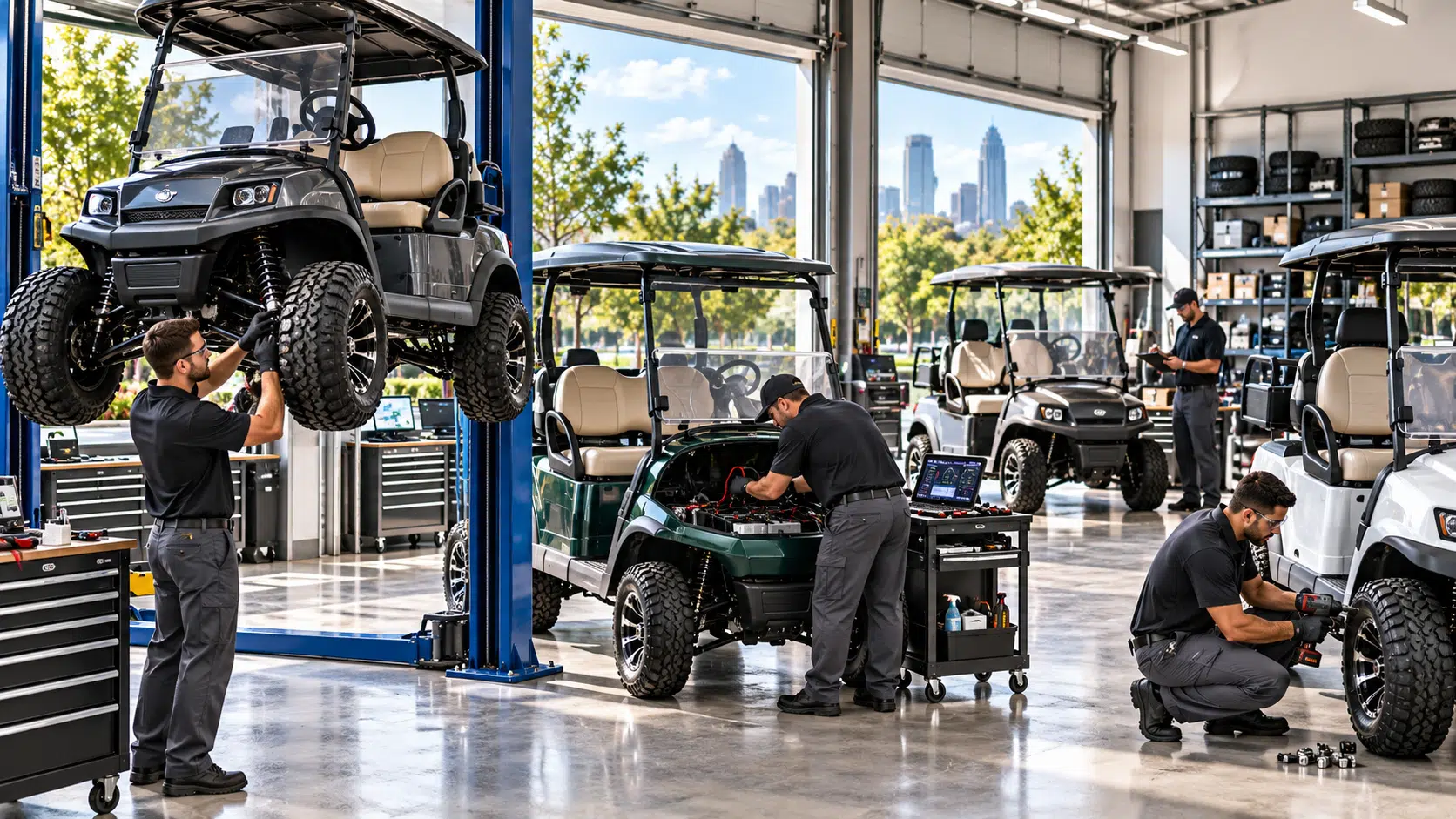
Golf cart battery maintenance comes down to a few habits: charge after each day’s use, add distilled water only after charging, keep the tops and terminals clean, and make sure every cable connection is tight. Do those consistently and a flooded lead-acid pack has its best chance at a long, dependable service life.
This checklist is built from Trojan Battery’s published maintenance and watering guides and E-Z-GO’s TXT 48V owner’s manual. Your own cart’s manual and your battery maker’s instructions come first, so keep them handy and follow them where they differ from anything here.
Why Golf Cart Battery Maintenance Matters
Most electric carts still run on flooded lead-acid batteries. Those batteries lose water during normal charging, collect corrosion on their terminals and suffer when they sit discharged. Trojan’s FAQ notes that operating in a partial state of charge, or storing a battery discharged, leads to sulfation that reduces performance and can shorten battery life.
The good news is that regular golf cart battery maintenance takes little time and few tools: safety glasses, gloves, distilled water, baking soda, a soft brush and a wrench. The eight steps below put those tools to work.
Your 8-Step Golf Cart Battery Maintenance Checklist
1. Gear Up and Work in a Ventilated Area
Every golf cart battery maintenance session starts with safety. Batteries hold acid and give off hydrogen gas while charging. Trojan recommends protective clothing, gloves and goggles, and says to keep flames, sparks and metal objects away from the batteries. E-Z-GO’s manual warns that a 4% concentration of hydrogen is explosive and suggests wrapping wrenches in vinyl tape so a dropped tool cannot short a battery.
On carts with a Run/Tow switch, E-Z-GO says to move it to the Tow/Maintenance/Storage position before any electrical service. Check your own manual for the switch location and procedure.
2. Charge After Each Day’s Use
E-Z-GO’s manual says to charge the batteries after each day’s use. Lead-acid golf cart batteries do not develop a memory, according to Trojan, so there is no benefit to running them down before charging.
In fact, Trojan recommends shallower cycles for the best life, generally a discharge of 20 to 50% of the battery’s rated capacity. Plugging in at the end of every day keeps you in that range on most routines.
3. Let the Charger Finish, Then Unplug
Charging too much is also a problem. Trojan’s FAQ says continuous charging speeds up corrosion of the positive plates and increases water loss. E-Z-GO’s manual says the charger should be checked after 24 hours and unplugged once the charge cycle is complete, and it advises against leaving a charger attached to an unattended cart beyond the normal cycle.
Charge in a well-ventilated space. E-Z-GO specifies an area with at least five air exchanges per hour.
4. Check Water Levels Monthly
Trojan’s quick battery watering guide recommends checking water levels monthly, especially with new batteries, so you learn how often your pack needs water. It is completely normal for flooded batteries to lose water as they charge.
The one rule you cannot break: never let the electrolyte drop below the top of the plates. If you open a cap and see exposed plates, add just enough distilled water to cover them before you start charging.
5. Top Off With Distilled Water After Charging
Trojan says the best time to water is at the end of the charge cycle, because adding water before charging a full battery can cause the electrolyte to overflow. Use distilled water; de-ionized water is acceptable but may still contain some minerals, and you should never add acid.
Fill only to the level your battery maker specifies. For its standard deep-cycle batteries, Trojan’s level is 1/8 inch below the bottom of the vent well. Do not overfill, then clean and secure the vent caps.
6. Clean the Battery Tops and Terminals
Keep batteries clean and dry. Trojan recommends cleaning acid residue or corrosion with a baking soda and water solution, then applying a protective spray or petroleum jelly to the terminals.
E-Z-GO’s manual gives a mix of 2 teaspoons of baking soda per quart of water, a dwell time of at least three minutes, a soft brush or cloth for scrubbing, and a low-pressure rinse with clear water. It warns against using a pressure washer.
7. Inspect Cables and Connections
Loose or over-tightened connections are a real hazard. Trojan’s flooded battery maintenance guide warns that connections that are too tight or too loose could result in post breakage, meltdown or fire. Use the torque values in your battery or cart manual rather than guessing.
While you are there, look along the cables. E-Z-GO says to inspect all wiring for fraying, loose terminations, corrosion or damaged insulation.
8. Store the Pack Fully Charged
Trojan’s guidance is simple: keep batteries fully charged before and during storage, never store them discharged, and keep them in a cool, dry place. E-Z-GO adds that batteries should be checked and recharged at least every 30 days while a cart sits.
A full charge also protects against cold weather. Trojan notes that a battery can only freeze when it is partially or completely discharged. If you need a replacement battery, charger or cable, you can request golf cart parts from our Marietta shop.

A Simple Golf Cart Battery Maintenance Schedule
It helps to tie each task to a trigger you will remember. Here is how the checklist above fits into a normal week and month, based on the Trojan and E-Z-GO guidance:
- After each day’s use: plug in the charger and let it complete the cycle, then unplug.
- Monthly, after a full charge: check the water level in every cell and top off with distilled water as needed.
- Monthly, or more often in dusty or wet conditions: clean the battery tops and terminals, as E-Z-GO’s manual recommends.
- Each time you clean: look over the cables, terminals and hold-downs for looseness, fraying or corrosion.
- During storage: check and recharge at least every 30 days.
Write the date and what you did on a card or in your phone. A simple golf cart battery maintenance log makes it easy to spot a pack that suddenly needs more water or loses range faster than it used to, which is often the first hint that something needs attention.
A Short Note on Lithium Golf Cart Batteries
Lithium packs change the routine. Trojan says its lithium golf cart batteries require no watering, can be charged anytime without harming the batteries, and include a self-protecting battery monitoring system.
That removes steps 4 and 5 from your list, but not the rest. Follow the battery maker’s charging and storage instructions, use the charger it specifies, keep the pack and cables clean, and inspect connections. Do not apply lead-acid steps such as watering to a lithium pack.
Signs Your Golf Cart Batteries Need a Technician
Routine golf cart battery maintenance prevents many problems, but some symptoms call for testing equipment and experience. Bring the cart in if you notice any of these:
- The cart’s range keeps shrinking even after a full charge.
- The charger shows a fault light or will not start a charge cycle.
- Corrosion returns soon after you clean it.
- A battery case is cracked, bulging or leaking.
- Cables or terminals feel hot after driving or charging.
Our shop handles diagnostics, batteries and chargers, and electrical repairs. Learn more on our golf cart service and repair page.
Frequently Asked Questions
How often should I add water to golf cart batteries?
Check the levels monthly, as Trojan recommends, and add water after charging when needed. How often you actually add water depends on how hard and how often you use the cart.
Can I use tap water in golf cart batteries?
Use distilled water. Trojan recommends distilled water and notes that even de-ionized water may contain minerals that can harm the battery. Mineral-rich tap water is best avoided.
Should I charge my golf cart after every ride?
E-Z-GO’s manual says to charge after each day’s use. Lead-acid batteries have no memory, so frequent charging is fine, but unplug once the charger finishes its cycle.
Do lithium golf cart batteries need maintenance?
They need less. Trojan’s lithium packs require no watering, but you should still keep connections clean and tight and follow the battery maker’s charging and storage instructions.
Get Help With Your Golf Cart Batteries
Golf Carts Atlanta has serviced golf carts in metro Atlanta since 1995, including batteries, chargers and electrical systems. If you would rather hand off golf cart battery maintenance, call us at (770) 321-9300 Monday through Friday, 7am to 3pm, or contact us online to set up a battery check at our shop at 1680 Lower Roswell Rd, Marietta, GA 30068.