








Golf cart laws in Georgia depend on what kind of vehicle you are driving. A golf cart used off the course is regulated as a personal transportation vehicle (PTV), which may only use streets your city or county has approved, while a low-speed vehicle (LSV) may use roads posted at 35 mph or less but must be registered, insured and driven by a licensed driver.
This guide walks through golf cart laws in Georgia for each vehicle type, based on the Georgia Department of Public Safety and the Georgia Code as we reviewed them in October 2026. It is a plain-language summary, not legal advice. Laws change, and local ordinances add their own rules, so always check with your city or county before you drive.
Golf Carts, PTVs and LSVs: How Georgia Defines Each
Golf cart laws in Georgia use three separate terms, and the label on your vehicle decides which rules apply. The Georgia Department of Public Safety summarizes the definitions from the state code.
- Golf cart: a motorized vehicle designed and used only to carry people and equipment to play golf on a golf course, with an average speed under 15 mph under the statute’s test conditions.
- Personal transportation vehicle (PTV): generally a vehicle with at least four wheels, a top speed under 20 mph on level ground, an unladen weight of 1,375 pounds or less, and room for no more than eight people. Some three-wheeled carts that a local government approved before January 1, 2012, also qualify.
- Low-speed vehicle (LSV): a four-wheeled vehicle whose top speed is more than 20 mph but not more than 25 mph on a paved, level surface, built to the federal low-speed vehicle safety standard (49 C.F.R. 571.500).
The key point for most owners: once a golf cart leaves the course and is used for anything else, DPS says it is regulated as a PTV. Mobility aids, power wheelchairs, ATVs and multipurpose off-highway vehicles are excluded from the PTV definition.
7 Helpful Rules Behind Golf Cart Laws in Georgia
These seven rules cover the core of golf cart laws in Georgia: where you can drive, what paperwork you need and what equipment the state requires. Each one comes from the DPS summary or the Georgia Code sections it cites.
1. Drive a PTV Only Where Your Local Government Allows It
Under O.C.G.A. 40-6-331, a city or county may pass an ordinance that designates certain streets or paths for PTV use, either shared with regular traffic or reserved for PTVs, and it may set conditions for that use. If your local government has not designated a street, the PTV authorization does not reach it.
A locality that permits PTVs must post signs where state highways enter its boundaries to warn drivers that PTVs are authorized. The statute says the ordinance is not effective until those signs are posted.
2. Keep PTVs on Roads Posted 25 mph or Less
The DPS low-speed vehicle brochure states that PTVs are authorized only where the speed limit is 25 mph or less. That applies on top of any local designation, so a street must meet both tests.
Crossing a state highway is tightly limited. Georgia PTV rules allow it only at designated crossings built as active grade crossings and marked with the W11-11 warning sign. On city and county roads, the local authority designates the crossings.
3. Keep LSVs on Roads Posted 35 mph or Less
O.C.G.A. 40-6-362 says a low-speed vehicle may be operated only on a highway where the posted speed limit does not exceed 35 mph. An LSV driver has the same rights and duties as any other driver, with a few added rules in 40-6-361:
- An LSV is entitled to full use of a lane, and other drivers may not deny it that use.
- An LSV driver may not pass another vehicle in the same lane it occupies.
- An LSV may not be driven between lanes of traffic or between rows of vehicles.
- Two or more LSVs may not travel side by side in a single lane.
4. Know the Registration and Insurance Rules
Registration and insurance are where PTVs and LSVs differ most. O.C.G.A. 40-2-20 exempts electric-powered PTVs and golf cars from state registration. The DPS brochure lists these requirements:
- Electric PTV: no state registration and no insurance requirement.
- Gas-powered PTV: registration and insurance required.
- Golf cart used only on the course: no registration and no insurance requirement.
- LSV: registration and insurance required.
A local government may not require the PTV itself to meet state vehicle registration, inspection, title or tag requirements (this is about the vehicle, not the driver), but it may require local registration and licensing for a fee the statute caps at $15. Ask your city or county whether it issues a permit or decal.
5. Carry a Valid Driver’s License
A licensed driver is required for an LSV, and for a golf cart driven on a public road. For a PTV, Georgia DPS lists a valid driver’s license as required unless the driver is exempt under a local ordinance, and notes these rules may be altered by local ordinance, especially ordinances in place before January 1, 2012. Since only some older ordinances carry that exemption, assume a license is required unless your local rules clearly say otherwise.
6. Equip a PTV With the Required Safety Gear
O.C.G.A. 40-6-330.1 lists the equipment every PTV must have:
- A braking system suited to the vehicle’s weight and passenger capacity, including a parking brake.
- A reverse warning device that works whenever the vehicle is in reverse.
- A main power switch that disables the motive power circuit when off or when the key is removed.
- Headlamps.
- Reflex reflectors.
- Tail lamps.
- A horn.
- A rearview mirror.
- Safety warning labels.
- Hip restraints, hand holds, or a combination of the two.
PTVs used only in daylight under local ordinances adopted before January 1, 2012, are exempt from that list. LSVs follow the same lighting rules as other motor vehicles, plus either a properly affixed emblem or an amber strobe light, and DPS lists seatbelts as required for LSVs but not for PTVs.
7. Stay Off Sidewalks and Drive Sober
DPS lists sidewalks as off limits to golf carts, PTVs and LSVs alike, except where they cross driveways. The same guide notes that DUI, implied consent and reckless driving laws apply to all three.

PTV vs. LSV at a Glance
Here is the short version of golf cart laws in Georgia side by side, drawn from the DPS brochure. Local ordinances can change several of these for PTVs.
- Top speed: PTV under 20 mph; LSV more than 20 and up to 25 mph.
- Roads: PTV only on locally designated streets posted 25 mph or less; LSV on roads posted 35 mph or less.
- Registration and insurance: PTV not required if electric, required if gas; LSV required.
- Driver’s license: required for both, unless an older local ordinance exempts PTV drivers.
- Seatbelts: not required on PTVs; required on LSVs.
- Sidewalks: not allowed for either, except at driveways.
Check Your City or County Ordinance First
The state sets the outer limits, but golf cart laws in Georgia are filled in locally. Each city or county decides whether PTVs are allowed at all, which streets and paths they may use, where they may cross, and whether a local permit is needed.
Before you drive on a public street, check these points with your city clerk, police department or county website:
- Whether PTVs are authorized in your city or county, and on which streets or paths.
- Whether a local registration, permit or decal is required, and what it costs.
- Which intersections or crossings are designated for PTVs.
- Any local conditions on drivers, passengers or hours of use.
Rules in one city can differ from the next town over, so check again if you trailer your cart to a lake house, a relative’s neighborhood or an event venue.
Keep a Street-Driven Cart Road Ready
Following golf cart laws in Georgia also means keeping the required equipment working. Test the brakes, parking brake, headlamps, tail lamps, horn and reverse warning before you head out, and look at your tires before every ride. If a tire, light or brake part needs replacing, you can request golf cart parts from our Marietta shop.
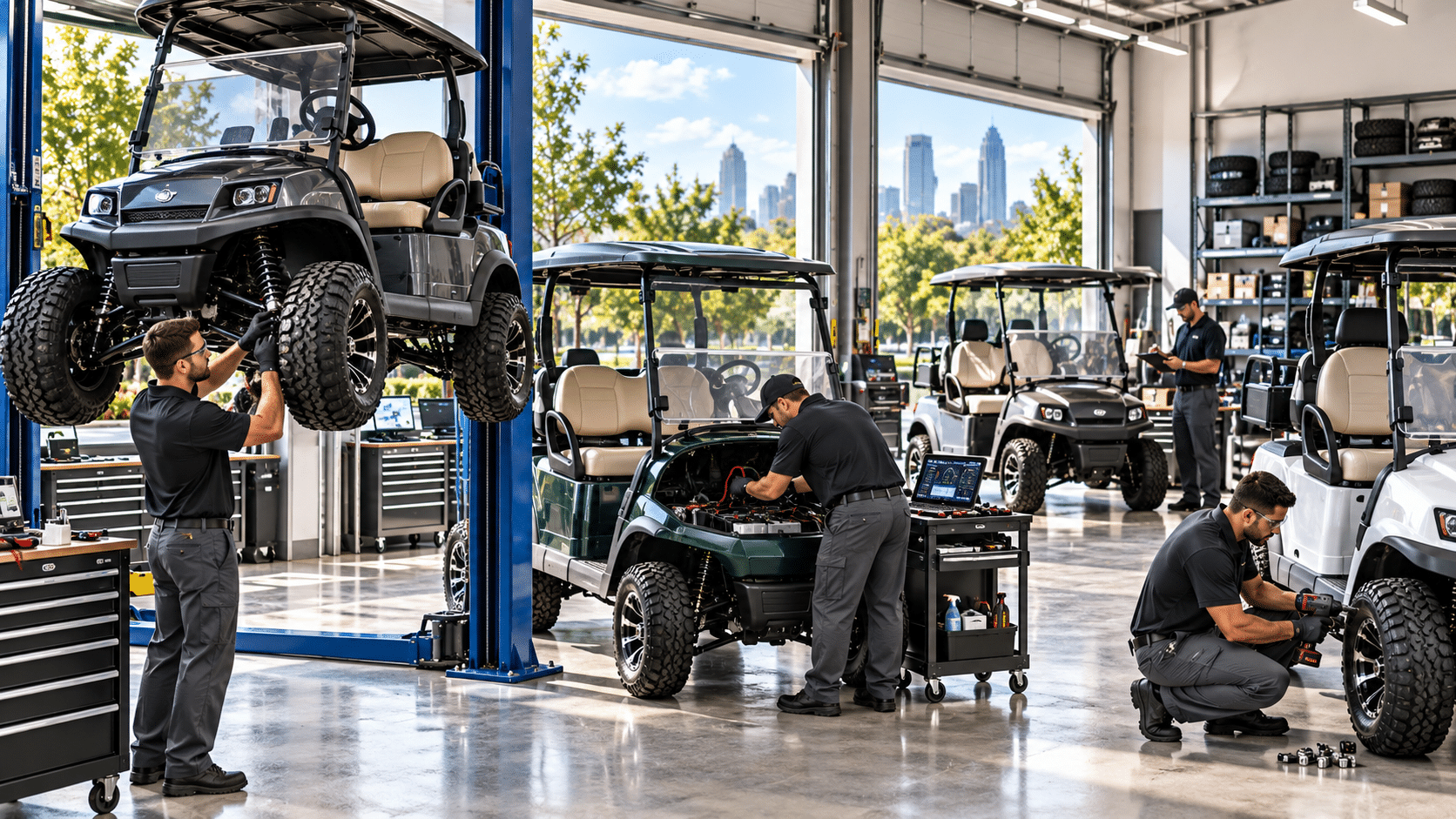
If a light, brake or switch is not working, our technicians handle diagnostics, brakes and electrical repairs at our Marietta shop. See our golf cart service and repair page for details.

Frequently Asked Questions
Do you need a license to drive a golf cart in Georgia?
Yes, in most cases. State law requires a valid driver’s license to operate a PTV on public streets unless a local ordinance adopted before January 1, 2012, says otherwise. LSV drivers always need a license.
Do golf carts need to be registered in Georgia?
Electric PTVs and course-only golf carts are exempt from state registration. Gas-powered PTVs and LSVs must be registered. Your city or county may still require a local permit for a fee capped at $15.
Can a golf cart cross a state highway in Georgia?
Only at a designated crossing built as an active grade crossing and marked with the W11-11 sign. On city and county roads, the local authority decides where PTVs may cross.
Is a low-speed vehicle the same as a golf cart?
No. A low-speed vehicle reaches more than 20 mph but no more than 25 mph and must meet federal LSV safety standards. That is why it may use roads posted up to 35 mph and must be registered and insured.
Talk to Golf Carts Atlanta About a Street-Ready Cart
Golf Carts Atlanta has sold, serviced and supplied parts for golf carts in metro Atlanta since 1995. If you have questions about a cart you own or one you are considering, call us at (770) 321-9300 Monday through Friday, 7am to 3pm, or send us a message. You can also visit us at 1680 Lower Roswell Rd, Marietta, GA 30068.
This article is general information about golf cart laws in Georgia, not legal advice. Check your local ordinance before driving on any public street.